
· by Michael Blair, Nashville's Flooring
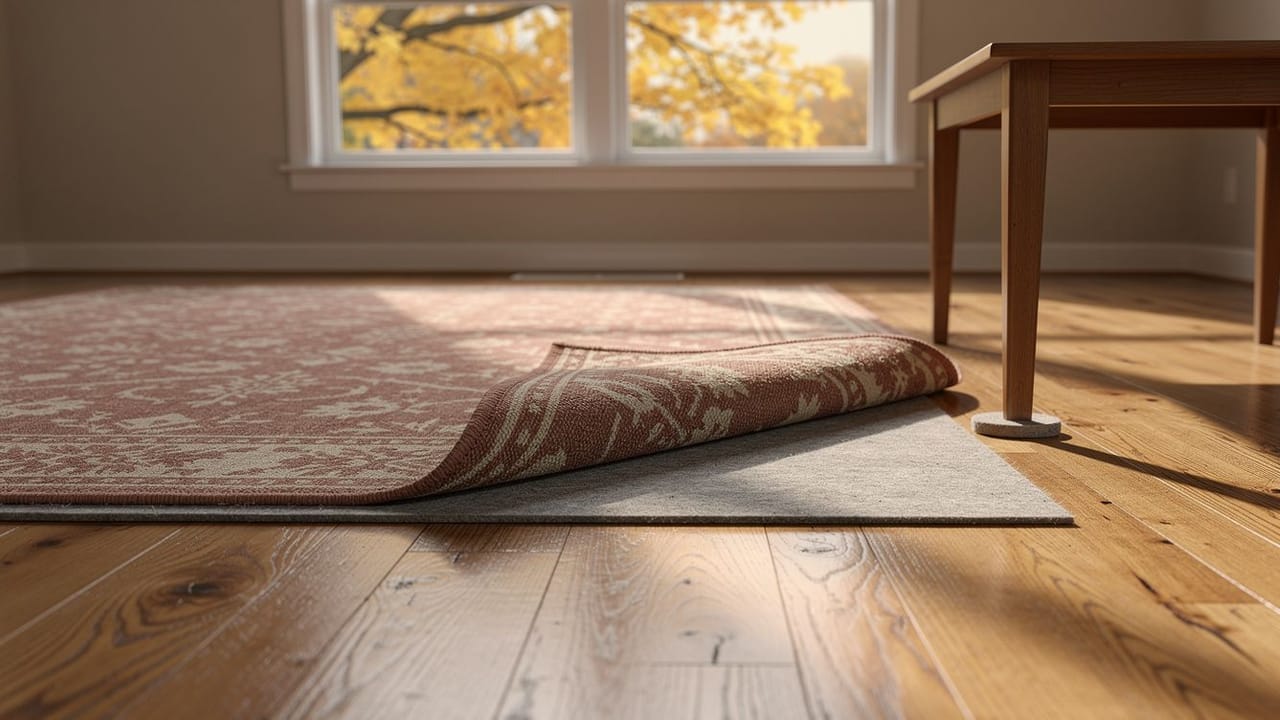
Fall is when the rugs go back down. The runner returns to the hall, a mat goes inside the back door for the wet leaves and the October rain, and the area rug that spent summer rolled up in the closet comes out for the living room. Very few people think about what is on the underside of those rugs, and that is where the trouble starts. The wrong backing can permanently discolor vinyl plank, and on a wood floor it can hold moisture against the boards for as long as the rug stays put.
The permanent stain on vinyl plank
This one is in writing from a manufacturer. Bruce’s care guide for its rigid core vinyl floors strongly recommends mats without a latex or rubber backing, because those backings may cause permanent discoloration. The guide does not explain the chemistry, and for a homeowner the word that matters is permanent: a cleaner will not lift it, and when we are called to one, the repair is replacing the affected planks of luxury vinyl plank.
Read the care guide for your own floor before the rugs go down, since Bruce is one maker and yours may say more. It matters for the warranty as well as the floor: the Resilient Floor Covering Institute’s maintenance guide tells owners that keeping a manufacturer’s warranty means following that manufacturer’s recommendations. On vinyl, that points to a mat with no latex or rubber on its underside, or a backing your floor’s maker names as acceptable.
What does a rubber-backed rug pad do to hardwood?
On wood, a sealed backing traps moisture against the boards. Bruce’s care guidelines for hardwood, laminate and WPC floors say not to use rugs with solid rubber or vinyl backings, and that a rug has to be made of a breathable material to prevent moisture entrapment. The same guidelines ask for indoor relative humidity between 30 and 50 percent, with an air conditioner or dehumidifier doing the work in the humid months. A wood floor already moves with the seasons, as our post on hardwood gaps in winter explains, and it has no use for a pad that keeps damp trapped under it.
Rugs cause a second kind of mark on wood that has nothing to do with the pad. Bruce’s hardwood guidelines say to move area rugs occasionally, because they block sunlight and can give the appearance of discoloring under the rug, and they recommend curtains and UV-resistant film on large glass doors and windows. In a sunny room, shifting a rug now and then is the cheapest protection a floor gets.
- A breathable pad under rugs on hardwood; plain felt is what we usually suggest
- No latex or rubber backing on vinyl plank
- No solid rubber or vinyl (PVC) backing under a rug that stays down on wood
- Check the flooring care guide before choosing any mat
Entry mats, chair mats and furniture feet
The mat inside the back door is the one most likely to cause trouble, because it is the one that gets wet. Bruce’s hardwood guidelines call for interior and exterior doormats at all entrances to collect dirt and moisture, and they describe fine grit acting like sandpaper on hardwood; the RFCI guide likewise plans walk-off mats into the entryways of resilient floors. The inside mat still needs a backing that suits the floor under it, and after a rainy day we would lift it and let the floor dry, since both Bruce guides say wet areas should be wiped up immediately.
Chair wheels and furniture legs are covered too. Bruce’s rigid core guide says rolling casters may damage the floor, and if you use them, double wheel types are the best option; its hardwood guidelines prefer barrel-type casters or wide, flat glides and suggest swapping hard, narrow rollers for wide rubber ones. Under a desk chair we suggest a smooth-backed mat made for hard floors rather than a carpet mat with gripper studs. For furniture, the rigid core guide asks for floor protectors that get wider as the piece gets heavier, and for heavy items to be walked across a plywood panel rather than slid over the floor.
Can a mark left by a rug be fixed?
On hardwood, what can be done depends on how deep the mark goes, and that is easier to judge in person than from a photo. Bruce’s guidelines send minor scratches to a touch-up kit, larger dull areas to a reconditioning coat of finish, and major damage to board replacement; our post on repairing hardwood without refinishing every room walks through the middle ground, and our refinishing work covers the rest. If a pad has stuck to the finish, lift it gently and follow the finish maker’s cleaning instructions. Bruce’s guidelines, for example, start with the company’s own floor cleaner on a soft cloth and turn to odorless mineral spirits only if a rubber mark remains.
On vinyl, a backing stain is permanent, so the fix is replacing the affected planks. How much work that is depends on whether the floor clicks together or was glued down, and it is far easier if a box of spare planks from the original install is still in the garage. The RFCI guide treats that spare material, which the trade calls attic stock, as something to plan storage for from the start. When our installers finish a floor, we leave the leftover planks and the maker’s care instructions with you, and this is exactly the kind of day they are kept for. If you have lifted a rug and are not sure what you are looking at, send us a note for an estimate.
Sources
- Bruce (AHF Products), Maintenance Recommendations for Residential Rigid Core Vinyl Floor Care (2020) — Latex or rubber mat backings may cause permanent discoloration; walk-off mats; rolling casters; floor protectors wider for heavier items; plywood panel for moving furniture; wipe up wet areas
- Bruce (AHF), Care and Maintenance Guidelines for Hardwood, Laminate and WPC Floors (2022) — No solid rubber or vinyl rug backings, breathable to prevent moisture entrapment; move rugs, they block sunlight; UV film; 30 to 50 percent humidity; doormats; grit like sandpaper; casters and glides; touch-up, reconditioning, mineral spirits for rubber marks
- Resilient Floor Covering Institute, Maintenance Application Guide (2024) — Follow manufacturers’ recommendations to maintain warranties; walk-off mats at entryways; storage for attic stock
FAQ
Rug Pads and Mats That Quietly Damage Floors — questions
Can I put a rubber-backed rug on luxury vinyl plank?
It is best not to. Bruce’s care guide for rigid core vinyl strongly recommends mats without a latex or rubber backing, because those backings may cause permanent discoloration. Check your own floor’s care guide as well, since following the maker’s recommendations is part of keeping the warranty.
What kind of rug pad is safe for hardwood floors?
One that breathes. Bruce’s hardwood care guidelines rule out rugs with solid rubber or vinyl backings and say the rug must be breathable to prevent moisture entrapment. We usually suggest a plain felt pad, and your own floor maker’s care guide has the final word.
Why is the floor a different color under my rug?
The rug has been blocking sunlight from that part of the floor. Bruce’s hardwood care guidelines say area rugs can give the appearance of discoloring underneath for that reason, and they recommend moving rugs occasionally and using curtains or UV-resistant film on large glass doors and windows.
How do you care for vinyl plank flooring?
Follow the care guide from the company that made your floor, since its recommendations are what keep the warranty valid. Bruce’s rigid core guide, as one example, asks for mats without latex or rubber backings, wet spots wiped up right away, double-wheel casters, protectors that widen as furniture gets heavier, and heavy pieces moved over a plywood panel.