
· by Michael Blair, Nashville's Flooring
When a flooring box says waterproof, it’s making a claim about the plank. The vinyl planks we install don’t swell when they get wet, and that’s a real advantage over laminate and wood. The label says nothing about where water goes once it’s on the floor, which is through the joints, under the planks and into whatever is below. Knowing the difference is what keeps a small leak from turning into a subfloor repair.
What is the difference between waterproof and water-resistant flooring?
We don’t know of a shared industry definition behind any of these words, so each manufacturer decides what its label means, and the place it’s spelled out is the warranty. On the boxes we see, waterproof usually goes on a vinyl or stone-polymer core. Water-resistant usually goes on laminate or engineered wood with a sealed surface, and the warranty often limits how long surface water can sit before it stops covering the floor. Moisture-tolerant is looser again, and we read it as a claim about humidity rather than standing water.
Read what kind of water the warranty actually covers. A glass knocked over and wiped up is a very different event from a dishwasher line seeping under the floor for a week, and the slow leak is the one that does the damage, because nobody sees it.
Where the water goes
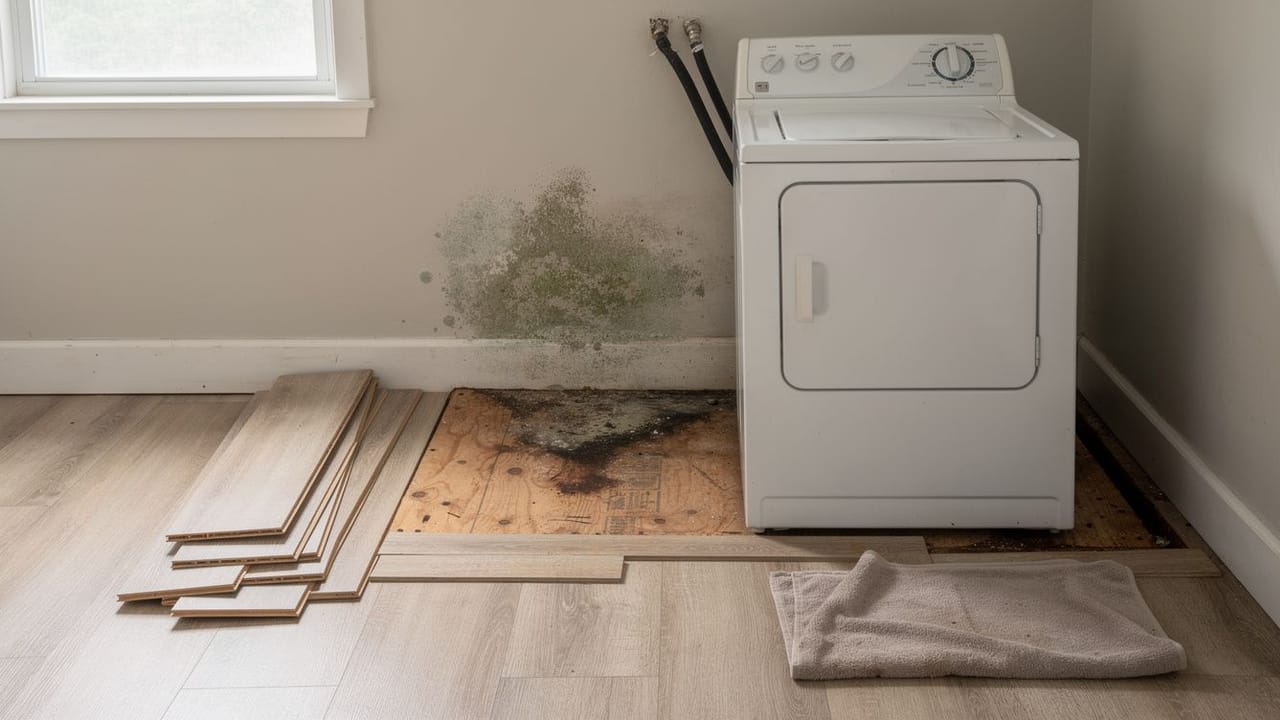
Click-lock floors float over the subfloor. Water on the surface finds the joints, and while a tight joint slows it down, we never count on one to keep a leak out. Once through, it sits on the underlayment and the plywood or OSB below. The vinyl plank on top usually comes through fine. The subfloor is where the trouble starts: EPA’s mold cleanup page says mold damages what it grows on, and the longer it grows, the more damage it can cause. Under a floor that looks perfect, it can grow for a long time.
Timing matters more than the label. EPA’s brief guide to mold and moisture says that if wet materials are dried within 24 to 48 hours of a leak or spill, mold won’t grow in most cases. A leak hidden under a waterproof floor is easy to miss for much longer than that.
Houses over crawl spaces have the most to lose. The Building America Solution Center’s crawlspace guide warns that crawlspace moisture promotes mold and rot along floor joists and rim joists, and that in humid climates like Middle Tennessee’s, water vapor in warm outdoor air can come in through the vents and condense on cooler framing. A leak from above adds water to framing that may already be damp from below, and it can go unnoticed until the floor develops a soft spot or a musty smell.
- Wipe up standing water promptly regardless of the label
- Treat appliance and plumbing leaks as subfloor events, not floor events
- Follow the manufacturer’s expansion gap and sealant instructions at walls, tubs and fixtures
- Lift a plank and look if a floor stays damp or smells musty, rather than waiting
Where does waterproof vinyl plank belong?
We put waterproof vinyl plank in bathrooms, laundries, mudrooms and basements, installed to the maker’s instructions at the walls and around the tub and toilet so water on the floor has a harder time getting in at the edges. Our luxury vinyl plank page covers the rest of where it earns its place. Water-resistant laminate is what we suggest for kitchens and living areas where spills get wiped up, and we keep it out of full bathrooms.
We don’t recommend engineered hardwood for any room with a floor drain, a tub or a washing machine. Solid hardwood handles a spill that’s wiped up quickly better than people expect, in our experience, and handles a slow leak badly. Boards that have cupped from a long soaking may not fully recover.
The slab, the crawl space, and moisture from below
None of these labels covers vapor coming up through a concrete slab or from a vented crawl space. On concrete, ASTM F2170, the standard test for relative humidity inside a slab, lists what too much moisture in the slab can do once a floor covering is down: debonding, peaking, deterioration of the finish flooring and microbial growth. A waterproof plank doesn’t prevent any of that, and it can hold the moisture underneath. The same standard notes that flooring manufacturers generally require moisture testing before installing over concrete, and that a result only describes the slab at the time and in the spots tested. We go through that testing in putting flooring over a Nashville concrete slab.
Over a crawl space, the fix starts on the ground. The same Building America guide says every crawlspace should have a polyethylene ground cover acting as a capillary break and vapor barrier, to keep ground moisture and soil gases out of the crawlspace. Ask any installer how they plan to handle moisture from below before the talk turns to product, because the floor is the last layer and does the least to keep the house dry. If you’d like that question answered for your own house, ask us for a free estimate.
Sources
- U.S. EPA, Mold Cleanup in Your Home — Mold damages what it grows on; the longer it grows, the more damage it can cause
- U.S. EPA, A Brief Guide to Mold, Moisture and Your Home — Materials dried within 24 to 48 hours of a leak or spill will in most cases not grow mold; fix leaks as soon as possible
- DOE Building America Solution Center (PNNL), Capillary Break at Crawlspace Floors — Crawlspace moisture promotes mold and rot along joists; humid outdoor air condenses on cooler framing; polyethylene ground cover in every crawlspace
- ASTM F2170-19a, Relative Humidity in Concrete Floor Slabs Using in situ Probes — Excess slab moisture causes debonding, peaking, deterioration and microbial growth; manufacturers generally require testing; results hold only for the time and spots tested
FAQ
Waterproof Flooring and What the Label Means — questions
Can waterproof vinyl plank go in a bathroom?
Yes, and it is what we usually suggest for one. The condition is that it is installed to the manufacturer’s instructions at the tub, toilet and walls, because the plank can come through a wet floor that the subfloor underneath may not.
Does waterproof flooring protect the subfloor?
No. The label refers to the plank. Water that gets through the joints or in at the edges reaches the subfloor, where it can do the same damage it always could, only out of sight. Prompt cleanup, fixing leaks right away and drying wet materials within 24 to 48 hours, the window the EPA gives for preventing mold, are what protect the subfloor.
Is water-resistant laminate good enough for a kitchen?
For a kitchen where spills get wiped up, yes. The risk in a kitchen is the slow leak from a dishwasher, an ice maker line or a sink trap, which most laminate won’t survive. Check under the sink and behind the dishwasher now and then and it should do well.
Is hardwood flooring waterproof?
No. In our experience solid hardwood copes with a spill that gets wiped up quickly better than most people expect, but a slow leak is another matter, and boards that cup after a long soaking may never fully flatten. We keep engineered hardwood out of any room that has a floor drain, a tub or a washing machine.